


Table of Contents
- What to Look for in Dog Car Seat Covers in 2026
- The Best Dog Seat Covers for SUVs and Trucks
- Why a Waterproof Dog Car Seat Cover Matters
- How to Install a Dog Car Seat Cover
- How to Clean a Dog Car Seat Cover
- Crash Safety and Restraint Compatibility
- Common Mistakes to Avoid When Buying Dog Car Seat Covers
- Conclusion
- Frequently Asked Questions
Last Updated: October 19, 2026
What to Look for in Dog Car Seat Covers in 2026
Most dog owners buy a cover after the damage is done: a torn seat, a soaked cushion, a trunk full of mud. Choosing the best dog car seat covers starts with three questions: fit, material, and how your dog rides. At Pawsome Finds, the difference between covers that survive years of muddy paws and ones that shred in a month comes down to a handful of specifications most listings bury.
Fit, Coverage, and Seat Configuration
Fit is the single biggest predictor of whether a cover works. A cover that doesn't match your seat geometry will slide, bunch, or leave exposed edges where claws and spills land.
Identify your configuration first.
Measure before you buy: rear seat width, depth, and whether the seat folds or splits. For trucks and SUVs, confirm whether you're covering the rear seat or the cargo area, these need different shapes entirely.
Materials, Waterproofing, and Durability
Waterproof and water-resistant are not the same claim. Waterproof fabric blocks liquid entirely, while water-resistant fabric slows absorption and eventually soaks through. For dogs that swim, drool, or travel with a water bowl, insist on waterproof.
Durability claims to verify:
- Scratch-resistant and tear-resistant surfaces, ideally with a quilted or ripstop pattern
- Reinforced seams where straps meet fabric
- Hard bottom panels on hammock styles, which keep the seat base from sagging
- Machine-washable materials that survive repeated cycles without cracking
Fabric choice is a trade-off. Quilted polyester blends resist claws and clean easily but trap heat; plush surfaces suit senior dogs but show fur and dirt faster. Match it to your dog.
The Best Dog Seat Covers for SUVs and Trucks
SUVs and trucks punish generic covers. Deep seats, fold-down split benches, and cargo configurations mean a sedan cover often leaves gaps or slides out of position. The best dog seat covers for SUVs and trucks are shaped for the vehicle, not stretched to fit it.
Matching Coverage to Your Cargo Area and Rear Seat
Decide where your dog rides before you shop. A dog secured in the rear seat needs a hammock or bench cover with headrest straps and seat anchors.
For split-folding rear seats, look for independent panels or a center zip so you can still fold one side down.
For crew-cab trucks, measure the rear bench width carefully: full-size and mid-size cabs differ by several inches, so a cover sized for one will overhang or fall short on the other.
Vehicle-Specific Fit Checks
Sedans. Rear benches are shallower front-to-back than SUV benches, with a steeper seatback angle, so a long hammock span may bunch at the crease.
SUVs. The common failure is seatback height.
Trucks. Crew-cab rear benches often have a shallow cushion, a nearly vertical seatback, and sometimes integrated headrests that won't accept loop-style straps.
Split-folding seats. Confirm the split ratio (40/20/40, 60/40, 50/50) and that the cover's panels match it.
Headrest layouts. Count your headrests and note whether they're adjustable or integrated.
Coverage checklist for SUVs and trucks:
- Confirm the cover reaches the full seatback height
- Verify side flaps cover the door-side bolsters
- Check that seat-belt access openings line up with your buckles
- Make sure headrest straps fit your headrest style (some trucks use integrated headrests)
- Confirm the cover's center seam aligns with your seat's split point
- Measure cushion depth and width at the widest point, not at the door opening
Why a Waterproof Dog Car Seat Cover Matters
A waterproof dog car seat cover protects the two things hardest to fix: the seat foam beneath the upholstery and the resale value of your vehicle interior.
The stakes are practical, not cosmetic. Wet dogs, overturned water bowls, motion sickness, and muddy paws all deliver moisture in volume.
Waterproofing also changes your cleaning routine. A waterproof surface wipes clean in seconds.
How to Install a Dog Car Seat Cover
Installation takes about five minutes and follows the same sequence for most hammock and bench covers. Getting the order right keeps the cover from shifting on the first drive.
Pawsome PawCruiser™ Backseat Extender →
- Remove the rear headrests if your cover's straps require it, then refit them through the strap loops.
- Drape the cover over the back seat, aligning the top edge with the seatback.
- Loop the headrest straps around each headrest and tighten until the top edge sits flat.
- Push the seat anchors into the crease between the seat base and seatback.
- Connect the hammock straps to the front headrests if you're using hammock style, adjusting so the fabric is taut but not stretched.
- Check seat-belt access openings and reposition if buckles are blocked.
- Press down on the non-slip backing across the seat base and confirm nothing slides.
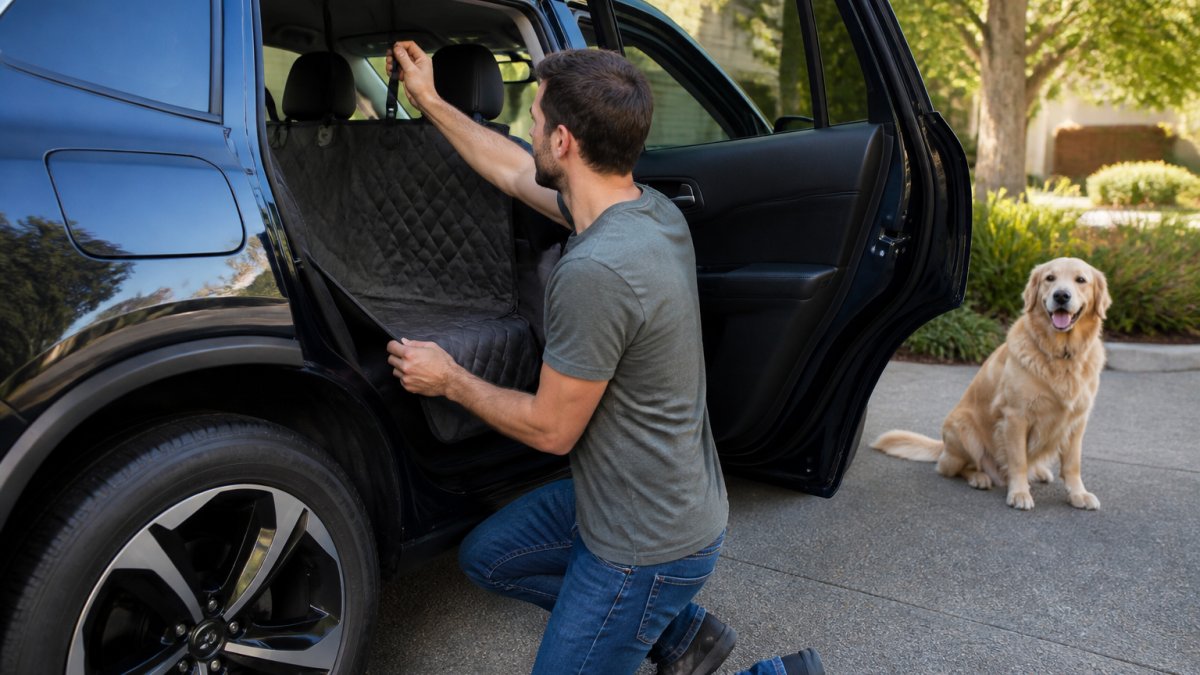
Expected result: the cover stays flat when you push sideways on the seat base, and no strap hangs loose. Recheck tension after the first trip, since new fabric settles.
How to Clean a Dog Car Seat Cover
Cleaning a dog car seat cover comes down to frequency and method: handle surface messes immediately, and deep-clean according to the material.
For routine cleaning:
- Shake out loose fur and dirt outside before bringing the cover indoors
- Wipe waterproof surfaces with a damp cloth and mild soap
- Vacuum quilted fabric with a brush attachment to lift embedded hair
- Spot-treat mud while damp, not after it dries
For deeper cleaning, check the care label first. Most machine-washable covers tolerate cold water on a gentle cycle, but heat damages waterproof membranes. Air-dry rather than machine-dry whenever possible. Avoid harsh detergents and fabric softeners, which can break down the water-repellent finish.
Crash Safety and Restraint Compatibility
Crash safety is where most buying guides go quiet, and it's the gap that matters most. A cover changes how your dog's restraint system interacts with the seat, and a loose cover can interfere with a harness or crate anchor. The distinction that matters: a cover is seat protection, not a safety device. No cover substitutes for a crash-tested harness or secured crate, and any listing implying otherwise is overstating the product.
Cover Features vs. Crash Protection
A cover can keep your dog from sliding on slick leather, contain mess, and keep claws off upholstery. It cannot restrain a dog in a crash and is not tested to hold a dog's weight under deceleration. Features like non-slip backing, seat anchors, and side flaps improve stability during normal driving, but stability is not restraint, treat them as comfort and protection features, not safety claims.
Buckle Access and Harness Routing
A few principles hold regardless of product:
- Never rely on the cover as a restraint. A cover is seat protection, not a safety device.
- Use a crash-tested harness or a secured crate, and confirm the cover's seat-belt access openings let you buckle the harness tether without routing straps through fabric.
- Check that the cover doesn't cover or compress the seat-belt buckle stalk, which can prevent proper latching.
- Avoid thick, padded covers under a crate, since they can create an unstable base.
Run these checks with your own harness before you commit to a cover:
- Buckle reach. With the cover installed, can you reach and latch the seat-belt buckle without lifting or folding the cover? If you have to peel back fabric, the opening is misaligned for your seat.
- Tether routing. If your harness uses a seat-belt tether, confirm the tether passes through the cover's opening without crossing a seam or strap. A tether that runs over fabric can chafe or slip.
- Stalk clearance. Check that the buckle stalk isn't compressed or covered. A stalk held at an angle by padding may not latch fully.
- Anchor stability. Push sideways on the seat base. If the cover shifts, the harness anchor point shifts with it, which is why seat anchors and a non-slip backing belong in your safety checklist, not just your comfort checklist.
Verifying Restraint Claims
The Center for Pet Safety publishes independent crash-test results for harnesses and crates, which is the right place to verify restraint claims. For general guidance on securing pets in vehicles, the ASPCA's pet travel safety guidance covers restraint and travel basics.
Fit and safety interact directly. A cover that slides forward under braking pulls against whatever is anchored to it. That's why a cover that fits your seat geometry is a safety consideration, not just a comfort one.
Common Mistakes to Avoid When Buying Dog Car Seat Covers
The same errors show up again and again, and each is avoidable with a little checking before checkout.
Skipping the non-slip backing. Without grip underneath, even a well-anchored cover shifts under braking and wears at the anchor points.
Overlooking seat-belt access. If the cover blocks your buckles, you'll either skip the harness or cut the fabric. Both are bad outcomes.
Conclusion
Choosing among the best dog car seat covers in 2026 comes down to fit, waterproofing, and restraint compatibility, not marketing language. Measure your seat, confirm the material is genuinely waterproof, and check that your harness or crate still works with the cover in place.
That's the standard we apply at Pawsome Finds. Our PawCruiser™ Backseat Extender is a waterproof, scratch-proof, non-slip hammock-style cover built for back seats and trucks, priced at $79.99, and it ships free with a 60-day money-back guarantee.

Frequently Asked Questions
What is the best dog car seat cover in 2026?
There is no single best cover for every dog and vehicle. The right pick depends on your seat configuration, your dog's size, and how much protection you need. Look for a waterproof dog car seat cover with a non-slip backing, full side flaps, and secure headrest straps. The Pawsome PawCruiser Backseat Extender at $79.99 is a hammock-style option that covers the rear seat and bridges the footwell gap.
Are dog car seat covers safe for dogs?
A seat cover itself is not a restraint, so it should not be treated as one. Choose a cover that leaves seat-belt access open so you can pair it with a crash-tested harness and tether. Avoid covers with loose straps or excess fabric a dog can tangle in. A secure, well-fitted cover keeps your dog from sliding around the back seat, which reduces distraction while you drive.
How do I keep a dog car seat cover from sliding?
Sliding usually comes down to a weak anchoring setup. Look for a cover with a non-slip backing, headrest straps, and seat anchors that tuck into the seat crease. Tighten every strap so the cover sits taut rather than loose. If your cover still shifts, check that the anchors are actually seated in the crease and that the headrest straps are adjusted evenly on both sides.
Are dog car seat covers waterproof and machine washable?
Many covers are water-resistant, but true waterproofing depends on the fabric and how the seams are finished. Check the listing for an explicit waterproof claim rather than assuming. For cleaning, most covers can be vacuumed and spot-cleaned, and many are machine washable on a gentle cycle. Always confirm the care instructions before washing, and air-dry rather than tumble-dry to protect the backing.
Your dog rides with you dozens of times a year. The right cover protects your vehicle interior, makes cleanup a two-minute job, and keeps your dog comfortable on every trip. Explore the PawCruiser™ Backseat Extender at Pawsome Finds and give your back seat the protection it needs before the next muddy adventure.