


Last Updated: October 25, 2026
Quick Summary
The best grooming tools for anxious dogs prioritize quiet operation and low vibration, including variable-speed clippers and grinders rated below 60 dB, non-motorized tools like slicker brushes and metal combs, and gentle alternatives like grooming mitts that eliminate noise and vibration entirely.
- Quiet tools should measure 10 dB or less above ambient room noise; use a phone sound-meter app held 12 inches away to verify dB ratings before buying.
- Variable-speed tools reduce vibration and noise compared to single-speed models; choose 6-12 oz handheld clippers and grinders that are light enough to control.
- Start desensitization with non-motorized tools like brushes and combs, then introduce powered tools only after your dog is calm around silent versions.
- Nail grinders work better than clippers for anxious dogs because they remove material gradually and avoid pinching; use the two-to-three-second rule to prevent heat buildup.
- Follow a five-week desensitization timeline: tool introduction, stationary contact, sound desensitization, light touch with sound, then actual trimming one nail per session.
Table of Contents
- Why Dogs Feel Anxious During Grooming
- Recognizing Stress Signals and Sensitivities
- Choosing a Quiet Dog Grooming Kit for Anxious Dogs
- Using a Dog Nail Grinder for Anxious Dogs Safely
- How to Calm a Dog When Grooming
- Desensitizing a Dog to Grooming Tools Step by Step
- Building Trust and Starting Your Grooming Routine
- Frequently Asked Questions
Why Dogs Feel Anxious During Grooming
Dogs feel grooming anxiety for straightforward reasons: unfamiliar sounds, unexpected touch, and loss of control trigger stress, especially after negative experiences, which is why the best grooming tools for anxious dogs prioritize quiet operation and gentle handling.
Some dogs are naturally more sensitive: loud noises startle them, vibrations feel threatening, and restraint creates panic. Rescue dogs or those with limited early socialization struggle most.
Recognizing Stress Signals and Sensitivities
Watch for these clear signs that your dog is stressed during grooming:
- Trembling or shaking
- Excessive panting or drooling
- Trying to escape or backing away
- Whining, growling, or snapping
Subtle signs matter too: a freezing dog is scared, not cooperative, and repeated lip licking or yawning signals anxiety.
Touch sensitivity varies by dog, some flinch at paw brushing, others panic at nail trimming but tolerate brushing. Identify the strongest triggers to build a plan.
Choosing a Quiet Dog Grooming Kit for Anxious Dogs
The right tools make a massive difference, but "quiet" and "low vibration" are marketing words until you define them. Evaluate tools with numbers, not adjectives.
What "low noise" should mean
Sound is measured in decibels (dB) on a logarithmic scale, a 10 dB increase sounds roughly twice as loud. A quiet room sits around 30 dB and conversation around 60 dB.
Look for a stated dB rating measured at a defined distance (typically 12 inches) and setting; "quiet motor" alone is unverified. Home test: use a free sound-meter app, hold your phone 12 inches away, and run the tool at your real working speed.
What "low vibration" should mean
Vibration is harder to quantify, but compare tools on three proxies:
- Motor type and speed settings. Variable-speed tools run slower, reducing vibration and noise; single-speed tools force the loudest, highest-vibration setting.
- Weight and balance. Look for 6-12 oz handheld clippers and grinders, light enough to control, heavy enough not to chatter.
- Build details. Rubberized grips, floating heads, and separate motor mounts reduce vibration; reviews mentioning "buzzing" or "chattering" are a warning sign.
Match the tool to the coat and the trigger
Let your dog's hardest trigger drive your first purchase:
- Noise-sensitive dog: Start with non-motorized tools, slicker brush, metal comb, grooming mitt, and add a variable-speed clipper or grinder only once the dog is calm around silent versions. Prioritize the lowest verified dB rating.
- Paw-sensitive dog: A small-head, adjustable-speed nail grinder is often easier than clippers because it removes material gradually and avoids pinching. Choose one with an LED light to see the quick and stop early.
- Long or double coat: Use a slicker brush, undercoat rake, and metal comb to work through tangles without pulling; detangling spray and a wide-tooth comb reduce tugging.
- Small dog or senior: Smaller heads, lighter bodies, and lower speeds matter more than power. A 6-8 oz grinder or compact clipper is easier to control around small paws and thin skin.
A task-organized starter kit
Build the kit by task, not brand, so you can substitute equivalents:
- Brushing and detangling: slicker brush, metal greyhound comb, undercoat rake (double coats), detangling spray.
- Shedding control: rubber curry or grooming mitt, silent, no vibration, good for dogs that tolerate touch but not tools.
- Clipping: variable-speed clipper with a stated dB rating, a #10 blade for hygiene areas, and blade coolant or a spare blade to avoid heat buildup.
- Nail care: variable-speed grinder with LED light and replaceable grinding bands, or plier-style clippers with a safety guard if your dog tolerates clipping better.
- Finishing: blunt-tip scissors for face and paw touch-ups, styptic powder for accidental quicks.
At Pawsome Finds, we understand that the best grooming tools for anxious dogs are those designed with their stress in mind. The PawSmooth Pet Nail Grinder combines a quiet motor with adjustable speeds and an LED light so you can work at your dog's pace. For dogs that tolerate brushing better than nail work, the Pawesome Grooming Mitt removes loose fur gently, with no loud sounds or vibrations.


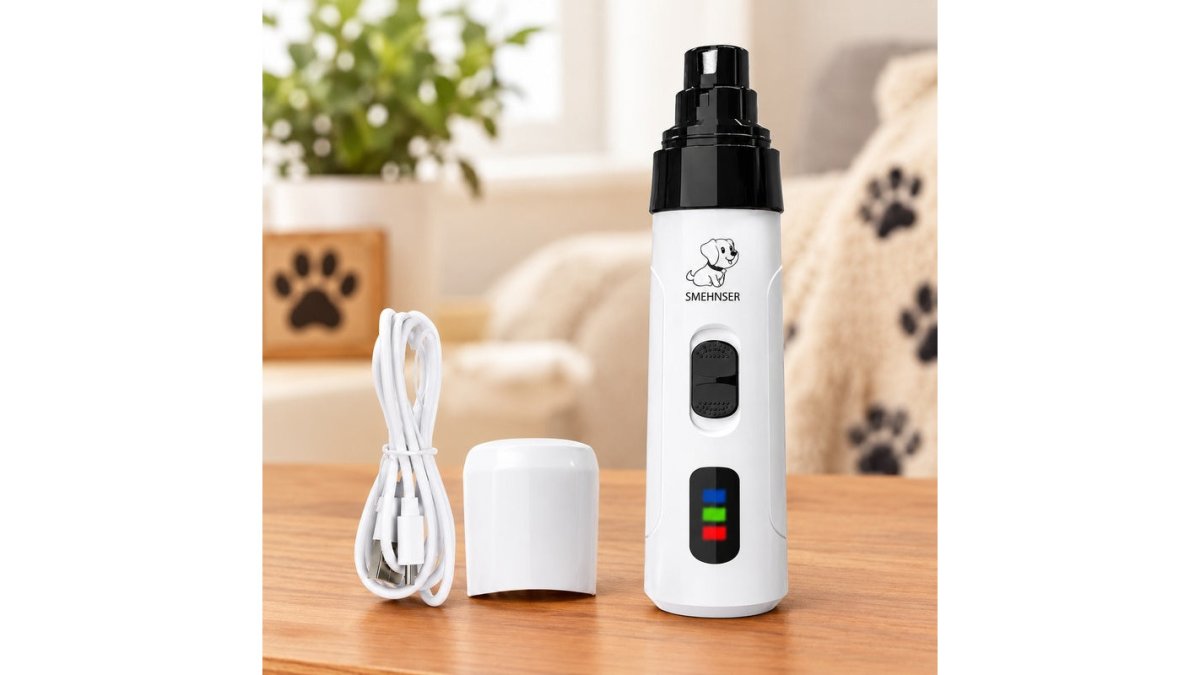
Choose tools that feel gentle in your hand, if you tense up, your dog senses it. Your comfort means your pet's calmness.
Using a Dog Nail Grinder for Anxious Dogs Safely
A dog nail grinder can be the gentlest way to trim nails if used correctly. Learn more about electric nail grinders and their safety features before using one on your anxious dog. Unlike clippers that pinch, a grinder smooths the nail gradually, which feels less threatening to anxious dogs. The trade-off: grinders generate heat and dust and can still hit the quick, so safety rules matter more than speed.
Before you start: the quick and the heat problem
The quick is the blood supply inside the nail, visible as a pink core on clear nails, invisible on dark ones, so grind in short passes and check the tip after each.
Grinder friction creates heat, and holding the band against one nail for more than a few seconds can burn the nail and quick. The rule most groomers follow: touch, count to two or three, lift off, and let the nail cool before the next pass.
The safe sequence
- Grinder off, dog calm. Let your dog sniff it and reward calm behavior. No paw handling yet.
- Grinder off, paw handling. Touch the tool to a nail for one second, reward, release. Repeat until the dog stops pulling away.
- Grinder on, away from the dog. Run it at working speed and reward calm behavior, separating the sound from paw handling.
- Grinder on, one nail, two seconds. Start with a back nail, which most dogs guard less. Lift off, reward, stop.
- Build one nail per session. Add a nail only when the dog stays relaxed through the previous count.
Stop criteria, when to end the session
Stop immediately and end on a reward if you see any of these:
- The dog pulls the paw away consistently on the same nail.
- Trembling that does not settle within a few seconds.
- Panting that is out of proportion to the effort, or drooling.
- Lip licking, yawning, or a rigid freeze, these are stress signals, not cooperation.
- Growling, snapping, or trying to bite.
If you quick a nail, apply styptic powder or cornstarch with light pressure, keep the dog calm, and end the session. Don't try to "finish" the remaining nails, the association you build in that moment lasts longer than the trim.
Aftercare and maintenance
Wipe dust from the paw and tool after each session. Replace grinding bands when they glaze or stop cutting, a dull band forces harder pressure, creating heat and quicking risk.
The PawSmooth Pet Nail Grinder is designed to reduce anxiety during nail care: its quiet motor and adjustable speeds let you work at your dog's comfort level, and the LED light helps you avoid the sensitive quick.
How to Calm a Dog When Grooming
Calm handling is your most powerful tool. Your dog reads your energy. If you're tense, they'll be tense.
Use a soft, steady voice. Talk in low, calm, reassuring tones and avoid sudden loud noises or excited energy, predictability calms anxious dogs.
Move slowly and deliberately. Rush creates panic; slow movements signal safety.
Take frequent breaks. Groom for two minutes, then stop, pet, treat, and let them walk around before resuming. Short sessions build confidence.
Treats and rewards work better than force. Offer high-value treats your dog loves, cheese, chicken, or special training treats. Reward them for:
- Staying still for a few seconds
- Letting you touch their paws
- Hearing the tool without reacting
- Allowing one nail to be trimmed
Physical touch matters too.
Desensitizing a Dog to Grooming Tools Step by Step
Desensitization is the most reliable way to help an anxious dog accept grooming.
Week 1: Tool introduction. Place the tool in your dog's living space without using it.
Week 5: Actual trimming. Trim one nail per session, stop, and reward heavily.
This timeline is a guide, not a rule.
Common mistakes:
- Rushing through desensitization
- Punishing fearful behavior
- Forcing the dog to accept tools before they're ready
- Skipping the reward step
- Grooming when the dog is already stressed
Patience pays off.
Follow this week-by-week timeline to help your anxious dog gradually accept grooming tools.
| Week | Focus | What to Do |
|---|---|---|
| 1 | Tool introduction | Place tool in living space, let dog investigate at own pace |
| 2 | Stationary contact | Hold tool near paw without turning on, touch gently to nail |
| 3 | Sound desensitization | Turn tool on in another room, gradually move closer over days |
| 4 | Light touch with sound | Turn tool on, touch to nail for one to five seconds, reward |
| 5 | Actual trimming | Trim one nail per session, add one nail per session thereafter |
Building Trust and Starting Your Grooming Routine
Trust is built through consistency and positive experiences, every session either builds trust or damages it.
Start when your dog is already calm, not right after play or excitement.
Watch for progress signs:
- Your dog walks toward the grooming area instead of hiding
- They relax faster than before
- They take treats calmly during grooming
- They stop showing stress signals
- They seem to enjoy the attention
These milestones show your dog is building confidence.
At Pawsome Finds, we believe every dog deserves grooming tools that respect their anxiety.
Start with one tool. Build your routine slowly. Watch your dog relax.
Grooming an anxious dog takes patience, but it's absolutely achievable.
Frequently Asked Questions
How can I tell if my dog is stressed during grooming?
Anxious dogs show clear stress signals: trembling, whining, tail tucking, ears pinned back, lip licking, or trying to escape. Some dogs freeze or become very still. If your dog displays these signs, stop grooming and take a break. Recognizing these signals early helps you adjust your approach before anxiety escalates, making future grooming sessions calmer.
What makes a dog nail grinder for anxious dogs different from regular clippers?
A quiet dog nail grinder for anxious dogs operates at lower noise levels and vibration speeds, which reduces sensory overload. The PawSmooth Pet Nail Grinder features a quiet motor and adjustable speeds, letting you work slowly and gently. The LED light also helps you see clearly without rushing, giving nervous dogs time to adjust to the tool's presence before you start grinding.
How long does desensitization to grooming tools usually take?
Desensitizing a dog to grooming tools typically takes 2-4 weeks with consistent, short daily sessions. Start by letting your dog see and sniff the tools without using them. Progress to touching the tools to their body without turning them on, then turn them on at a distance, then closer. Each step should feel comfortable before moving forward. Some dogs need longer; patience builds confidence and trust.
Can grooming mitt tools help with shedding if my dog is anxious?
Yes. The Pawesome Grooming Mitt is designed to feel like gentle petting, so it's less likely to trigger anxiety than clippers or grinders. It removes loose fur while you pet your dog normally, turning grooming into bonding time. For anxious dogs, starting with a grooming mitt can build positive associations with grooming before introducing other tools like nail grinders.
