


Table of Contents
- Why Dog Hair Clings to Couches (and What Actually Loosens It)
- What You'll Need Before You Start
- How to Get Dog Hair Out of Couch Fabric: Step-by-Step
- The Best Pet Hair Remover for Couch: Tools Compared
- How to Remove Dog Hair From a Leather Couch
- How to Prevent Dog Hair on Couch Surfaces
- Common Mistakes to Avoid
- Conclusion
- Frequently Asked Questions
Last Updated: October 17, 2026
Why Dog Hair Clings to Couches (and What Actually Loosens It)
Dog hair clings to couch fabric because of static, friction, and the tiny barbs on each strand, which lock into woven fibers like hooks. That is why a quick wipe often pushes fur deeper instead of lifting it out.
Pet parents often tell us they've tried three or four tools with no luck. The problem is rarely effort, it's technique.
Most guides treat all upholstery the same, but a microfiber sectional and a leather recliner need completely different methods. Use the wrong one and you risk scratching the surface or grinding fur further in.
Below, we break down the best ways to remove dog hair from couch cushions, seams, and crevices, plus a fabric-by-fabric plan and tool comparison.
The ASPCA's pet care library notes that regular grooming reduces how much loose fur ends up on furniture in the first place. That matters, because shedding is constant, not seasonal for many breeds.
What You'll Need Before You Start
Gather your tools before you start, stopping mid-job lets fur settle back into the fabric.
Here is a simple starter kit:
- A vacuum with an upholstery attachment
- A rubber glove or rubber-edged tool
- A reusable roller or lint roller
- A spray bottle with plain water
- A damp microfiber cloth
- A pet-hair rake for deep-set fur
- A small brush for seams and crevices
Skip dryer sheets on most fabrics; they leave a residue that can stain lighter upholstery.
Test any liquid on a hidden spot first, a quick check on the back of a cushion saves you from a ruined sofa.
How to Get Dog Hair Out of Couch Fabric: Step-by-Step
Learning how to get dog hair out of couch fabric comes down to three moves: vacuum, loosen, lift.
Work in small sections, finishing one cushion before moving on, so you don't spread hair around.
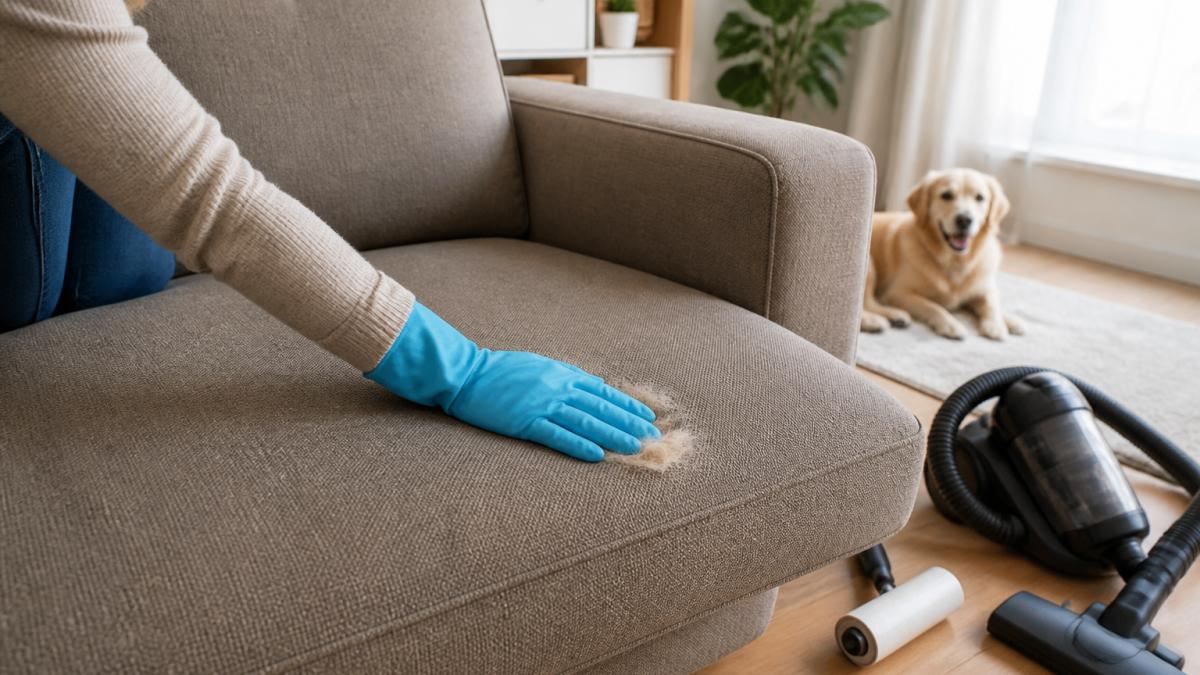
Step 1: Vacuum the Cushions and Crevices First
Start with the vacuum and upholstery attachment, running it slowly across each cushion in overlapping passes.
Do not press hard. Light, steady pressure pulls surface hair up without driving it deeper.
Then switch to the crevice tool: seams and the gap behind the cushions hide the most fur.
- Vacuum both sides of removable cushions
- Hit the seams and piping
- Run the crevice tool along the back gap
- Empty the canister before it fills
A clogged vacuum loses suction fast. Empty it when it hits the halfway mark.
Step 2: Loosen Embedded Fur With Moisture or Rubber
Embedded fur needs help: a light mist of water breaks the static bond holding hair to fabric.
Spray a fine mist, not a soak. Wait ten seconds. Then drag a rubber glove or rubber-edged tool across the surface.
The rubber creates friction, so hair clumps together and lifts off instead of scattering.
Step 3: Lift and Collect What's Left
Now grab your reusable roller or lint roller. Roll in short strokes, peeling the sheet or emptying the chamber as it fills.
For stubborn spots, press the roller down and roll slowly, speed doesn't help.
Finish with a damp cloth to pick up fine dust and dander the roller missed, rinsing often.
That three-step loop, vacuum, loosen, lift, is what separates a couch that looks clean from one that actually is.
The Best Pet Hair Remover for Couch: Tools Compared
The best pet hair remover for couch use depends on your fabric and how deep the fur sits, no single tool wins everywhere. Score each on hair removed per pass, time per cushion, effort, cleanup, and durability.
| Tool | Best for | Hair per pass | Time per cushion | Effort | Cleanup | Durability |
|---|---|---|---|---|---|---|
| Rubber glove | Quick touch-ups | Low-medium | 1-2 min | Low | Rinse under tap | Months |
| Reusable roller | Everyday maintenance | Medium | 1 min | Low | Rinse or peel chamber | 1-2 years |
| Lint roller (disposable) | Small areas, travel | Medium | 1 min | Low | Peel and discard sheet | Until sheets run out |
| Pet-hair rake | Embedded fur in woven fabric | High | 2-3 min | Medium | Comb out bristles | Years |
| Vacuum upholstery brush | Large surfaces | Medium-high | 30 sec | Low | Empty canister | Years |
| Damp microfiber cloth | Final pass, dander | Low | 1 min | Low | Machine wash | Months |
A rubber tool plus a reusable roller covers most homes. Add a rake only if fur keeps returning after two full passes on woven or tweed fabric.
How to Maintain Each Tool (and Dispose of the Hair Without Redistributing It)
A dirty tool spreads more hair than it removes. Upkeep:
- Rubber glove or rubber-edged tool: Rinse under warm water and rub the collected hair off into a trash can, not the sink. Hair down a drain clogs pipes. Dry before storing.
- Reusable roller: Open the chamber over a trash can and tap the collected fur out. Rinse the roller surface with water and let it air-dry standing up so the adhesive or bristles do not flatten.
- Lint roller: Peel sheets slowly and fold them sticky-side-in before discarding. This keeps loose fur from drifting back onto the couch.
- Pet-hair rake: Comb the bristles out over a trash can after every use. A rake packed with old fur pulls less new fur.
- Vacuum attachments: Empty the canister at the halfway mark, a clogged vacuum loses suction fast. Rinse washable filters monthly and let them dry fully before reinstalling.
- Microfiber cloths: Wash separately from lint-producing fabrics. Dryer lint from a load of towels will re-deposit on the cloth and then on your couch.
Safety Around Pets, Kids, and Sensitive Upholstery
A few habits keep the job safe for everyone:
- Skip dryer sheets on most fabrics. They leave a residue that can stain lighter upholstery, and the coating can irritate a pet's skin or eyes if your dog licks the cushion. If you use one, keep it to a hidden test spot first.
- Mist, do not soak. Too much water can stain or warp cushions and can promote mildew in the padding. A fine mist that dries in under a minute is the target.
- Keep pets out of the room during the loosening step. Loose fur in the air is easy for a dog to inhale, and a curious nose will undo your work.
- Check cleaning products against your pet's sensitivity. Many common upholstery sprays contain fragrances and surfactants that are fine for fabric but not for a dog that naps on it. Rinse or vacuum residue before letting your pet back on the couch.
- Test any liquid on a hidden spot first. A quick check on the back of a cushion saves you from a ruined sofa.
For grooming at the source, our Pawesome Grooming Mitt collects loose fur straight from your dog's coat. It turns shedding into cuddle time, and it means less hair ever reaches the couch. At $29.99, it offers a convenient way to manage shedding.

How to Remove Dog Hair From a Leather Couch
Leather is the easiest upholstery to clean and the easiest to ruin. Skip the rake and stiff brush: use a damp microfiber cloth or rubber glove, wipe in one direction with light pressure, then follow with a dry cloth. Hair sits on the surface rather than weaving in, so it lifts in one or two passes.
For seams and piping, a soft detailing brush beats a vacuum brush, which can scuff the finish. Condition the leather after cleaning, dry leather holds more static, and static pulls hair right back onto the seat.
Fabric-by-Fabric Plan (and Why One Method Fails Everywhere)
Most guides treat upholstery as one material, but the rubber glove that rescues a microfiber sectional can snag velvet or scratch leather. Before you touch anything, do two things:
- Check the care label. Look for a W (water-based cleaner), S (solvent-based cleaner only), WS (either), or X (vacuum only). An S or X label means no water mist, skip the spray bottle step and rely on dry tools.
- Spot-test on a hidden area. The back of a cushion or the underside of a skirt is ideal. Apply your method to a 2-inch square, wait ten minutes, and check for color lift, pilling, or a water ring.
Here is how the main fabric types behave:
| Fabric | What works | What to avoid | Why |
|---|---|---|---|
| Microfiber | Rubber glove, damp cloth, vacuum brush | Stiff brushes, heavy moisture | Tight weave traps fine fur; moisture can leave rings |
| Velvet / velour | Soft brush, low-suction vacuum, reusable roller | Rubber tools, stiff bristles, rakes | Pile crushes and snags permanently |
| Chenille | Reusable roller, gentle vacuum, rubber glove with light pressure | Rakes, back-and-forth scrubbing | Looped fibers pull and fray |
| Leather / bonded leather | Damp cloth, rubber glove, soft detailing brush | Rakes, vacuum brushes, water soaks | Surface scratches and finish dulling |
| Woven / tweed | Rubber glove, pet-hair rake, vacuum brush | Over-wetting | Loose weave hides fur deep in the weft |
| Delicate / silk blends | Reusable roller only, low-suction vacuum | Moisture, rubber friction, rakes | Fiber damage is irreversible |
The Deep-Embedded Fur Sequence
When fur has been ground into seams and textured fabric for weeks, one pass won't cut it. Use this sequence:
- Dry-vacuum first with the upholstery attachment, light pressure, overlapping passes.
- Switch to the crevice tool and run it along every seam, piping line, and the gap behind the back cushions.
- Loosen with friction, rubber glove or rubber-edged tool, one direction only, working in 12-inch sections.
- Mist lightly (only if the care label allows water) and wait ten seconds before the next pass.
- Lift with a reusable roller, pressing down and rolling slowly.
- Finish with a damp cloth to catch dander and fine dust the roller missed.
Repeat steps 3 through 5 on any spot that still feels gritty under your palm. Two full cycles handle most embedded fur; a third is rarely needed.
How to Prevent Dog Hair on Couch Surfaces
Prevention beats cleaning every time, stop hair before it settles.
Try these habits:
- Groom your dog two to three times a week
- Use a washable throw blanket on your dog's favorite spot
- Vacuum the couch weekly, not monthly
- Keep a rubber glove near the couch for quick passes
- Bathe your dog on a regular schedule for their coat type
A dedicated blanket is the single biggest win. Your dog gets a spot that smells like them, and you wash the blanket instead of the whole couch.
Our grooming mitt fits into this routine well. A few minutes of petting collects the loose fur before it spreads.
Common Mistakes to Avoid
Most failed attempts trace back to the same errors.
- Skipping the vacuum step. Rubber tools work far better on already-vacuumed fabric.
- Soaking the fabric. Too much water can stain or warp cushions. Mist lightly.
- Using dryer sheets on light fabric. The residue attracts more dust and can leave marks.
- Pressing too hard with the vacuum. Heavy pressure drives fur deeper into the weave.
- Ignoring the seams. Crevices hold more hair than the visible cushion tops.
- Using one tool for every fabric. Leather and microfiber need different handling.
Conclusion
Dog hair on the couch is a constant battle for anyone with a shedding breed. The good news is that the right order of steps, vacuum, loosen, lift, solves most of it without fancy gadgets.
The Pawesome Grooming Mitt catches loose fur at the source, our free worldwide shipping gets it to your door, and our 60-day money-back guarantee means you can try it risk-free.
Get started with Pawsome Finds and spend less time fighting fur and more time enjoying your dog.
Frequently Asked Questions
What is the most effective pet hair remover for a couch?
For most fabric couches, a rubber tool or damp cloth loosens embedded fur better than dry brushing, because the friction pulls hair out of the weave instead of just pushing it around. A vacuum with an upholstery attachment handles the surface layer. For heavy shedding, a reusable roller or a grooming mitt used on your dog before couch time cuts down how much hair reaches the cushions in the first place.
Can a rubber glove remove dog hair from a couch?
Yes. A damp rubber glove works well on fabric and microfiber because the rubber grabs loose and lightly embedded hair as you wipe. Put the glove on, dampen the palm slightly, and sweep in one direction across the cushion. Rinse the glove into a trash bin when it builds up. It is a good low-cost first pass, though deeply embedded fur may need a vacuum or a pet-hair rake afterward.
How do you remove dog hair from a leather couch?
Leather is easier than fabric because hair sits on the surface instead of weaving in. Wipe the couch with a damp microfiber cloth in one direction, then dry it right away so moisture does not sit on the leather. A soft rubber brush or a vacuum with a brush attachment handles stubborn patches. Avoid abrasive scrubbers that can scratch the finish, and condition the leather occasionally to keep it from drying out.
How often should you clean dog hair off your couch?
For a heavy shedder, a quick pass every two to three days keeps hair from building up in seams and cushions. A deeper clean with a vacuum and rubber tool once a week is usually enough for average shedding. If anyone in the home has allergies, aim for every other day, since dander travels with the hair. Covering the couch with a washable throw can stretch the time between full cleanings.