


Last Updated: November 10, 2026
Quick Summary
Choose a travel bowl by matching material, capacity, and stability to your dog and trip: silicone or TPE for water breaks on hikes, stainless steel for full meals and car travel. Size the bowl to a measured meal and carry roughly 1 ounce of water per pound of body weight per day.
- A collapsible pet bowl weighs about 65 grams and opens into a 350 ml bowl.
- Small dogs typically need 1 to 2 cups for a full meal; large dogs 3 cups or more.
- Two 350 ml collapsible bowls hold about 24 ounces, enough for a half-day hike for a 40-pound dog.
- A wide base and weighted bottom do more for spill control than any lid.
- Rinse every bowl after each use and stand collapsible bowls on edge to dry.
Table of Contents
- Why the Right Travel Bowl Matters on the Go
- Collapsible, Foldable, and Rigid: Types of Travel Bowls
- Comparing Materials: Silicone, TPE, Plastic, and Stainless Steel
- What Makes the Best Travel Dog Bowl for Your Dog
- Travel Dog Bowl for Car Rides: Leakproof and Spill-Resistant Features
- Why a Travel Dog Bowl with Lid Belongs in Your Pack
- Calculating Water and Food Capacity for a Specific Outing
- Cleaning, Drying, and Preventing Odor Buildup
- Frequently Asked Questions
Why the Right Travel Bowl Matters on the Go
A travel bowl is a portable food or water vessel that lets your dog eat and drink away from home without spills, leaks, or a soggy backpack. Pet parents often find that the bowl grabbed at the last minute is the one that fails on the road.
Below, we'll show you how to match a bowl to your dog, your trip length, and your activity, so you buy once instead of three times. What separates a bowl that works from one that ends up in a junk drawer comes down to four things: material, capacity, stability, and how it seals.
Collapsible, Foldable, and Rigid: Types of Travel Bowls
Three designs cover almost every situation: collapsible silicone bowls, foldable fabric-and-liner bowls, and rigid bowls with fixed walls. Each solves a different problem, and picking the wrong type is the most common mistake we see.
The Collapsible Dog Bowl Advantage
A collapsible dog bowl is the lightest option and the easiest to clip to a leash or belt loop. Our collapsible pet bowl weighs about 65 grams, folds into a compact disc, and opens into a 350 ml bowl.

Where it falls short: a soft-sided bowl has no weight of its own, so a dog that paws at the rim can push it across the ground. It suits water breaks and short outings better than full meals.
Rigid and Dual-Compartment Designs
Rigid bowls hold their shape, resist tipping, and handle a full meal without collapsing. Our non-slip dual-use stainless steel pet bowl comes in small, medium, and large with a non-slip base, and is made of durable stainless steel that is easy to clean.

The trade-off is packed size. A rigid bowl takes up real room in a bag, so it fits best in a car console, a tote, or a hotel room rather than a running vest.
| Type | Packed Size | Best For | Main Weakness |
|---|---|---|---|
| Collapsible silicone | Very small, folds flat | Hikes, walks, water breaks | Tips easily when empty |
| Foldable fabric | Small, lightweight | Short trips, backup bowl | Liner can wear at seams |
| Rigid stainless steel | Bulky, fixed shape | Meals, car travel, hotel stays | Takes up bag space |
| Dual-compartment rigid | Bulky, one unit | Full-day outings | Heavier than soft bowls |
Comparing Materials: Silicone, TPE, Plastic, and Stainless Steel
Material decides how a bowl ages, how safe it is at the food-contact surface, and how much maintenance it demands. The four you will see most are silicone, TPE, rigid plastic, and stainless steel.
Silicone
Food-grade silicone is flexible, heat-tolerant, and does not hold odors the way soft plastics can. It handles warm soapy water and generally tolerates top-rack dishwasher cycles, though confirm the manufacturer's guidance because some collapsible designs trap water in the fold layers. The weakness is structural: with little mass, a silicone bowl slides or flips when a dog paws at the rim, and it attracts lint and hair on trail.
TPE (Thermoplastic Elastomer)
TPE folds like silicone and often costs less, which is why it shows up in budget collapsible bowls. It is generally food-safe when formulated for food contact, but it holds odor longer than silicone and can stiffen or discolor with sun exposure. Over many fold cycles, TPE is more prone to stress cracking along the crease lines.
Rigid Plastic
Rigid plastic is cheap, light, and holds its shape, making it reasonable for a car console or hotel room. The trade-off is surface wear: plastic scratches, and scratched plastic gives bacteria somewhere to settle. Avoid hot food or water and hot cars, where it can warp permanently. A plastic bowl with deep scratches or a sour smell after cleaning is a replacement candidate.
Stainless Steel
Stainless steel is the most durable option for daily feeding and watering on the road. It resists wear, does not hold smells, wipes clean quickly, and stays cooler than plastic in a hot car. It is heavier than the soft options and takes up fixed space in a bag, so it suits meals at a campsite or hotel better than a running vest.
What "Food-Grade" Actually Covers
A common mistake is buying a bowl labeled "food-grade" without checking what that claim covers. The term should mean the food-contact surface was made from a material intended for food, but it says nothing about the lid, rim, or base. Food-grade silicone and stainless steel are the two materials most practitioners trust for daily feeding and watering on the road.
Matching Material to Use
For water breaks on hikes and walks, silicone or TPE wins on packed size and weight. For full meals and car travel, stainless steel wins on stability and cleanup.
| Material | Food-Contact Safety | Heat Behavior | Odor Retention | Durability | Best Use |
|---|---|---|---|---|---|
| Food-grade silicone | Good when labeled for food contact | Tolerates warm water; confirm dishwasher guidance | Low | Good; can tear at thin folds | Hikes, walks, water breaks |
| TPE | Generally food-safe when formulated for food | Can stiffen with sun exposure | Moderate to high | Fair; crease cracking over time | Budget collapsible bowls |
| Rigid plastic | Acceptable when labeled food-grade | Warps in hot cars | Moderate; scratches harbor residue | Fair | Car console, hotel backup |
| Stainless steel | Good | Stays cooler; no warping | None | Excellent | Meals, car travel, campsite |
Watch out: a soft plastic bowl left in a hot car can warp permanently, and a bowl that smells sour after cleaning usually has residue trapped in a seam or scratch.
What Makes the Best Travel Dog Bowl for Your Dog
The best travel dog bowl is sized to your dog's meal and stable enough to stay put while they eat, then matched to how long you will be out. Capacity and stability matter more than brand or color.
Step 1: Size the Bowl to the Meal
Match bowl volume to meal size, not breed name. Small dogs typically need 1 to 2 cups for a full meal, medium dogs around 2 to 3 cups, and large dogs 3 cups or more. For a deeper walkthrough, our guide on how to choose the best puppy feeding bowls breaks sizing down by growth stage.
Step 2: Estimate Water for the Outing
Plan on roughly 1 ounce per pound of body weight per day as a starting point, then adjust for heat, activity, and refill access. A 40-pound dog needs roughly 40 ounces per day; a half-day hike is about half that, so roughly 20 ounces, plus a quarter more for hot weather or steep trails.
Step 3: Match the Bowl Type to the Trip
Use a simple decision table rather than guessing. The trip length and activity level should pick the bowl type for you.
| Dog Size | Trip Length and Activity | Recommended Setup | Why |
|---|---|---|---|
| Small (under 25 lb) | Short walk or errand | One collapsible silicone bowl | Light, clips to leash, enough for a water break |
| Small | Half-day hike | One collapsible bowl plus a small rigid bowl for meals | Splits water and food without bulk |
| Medium (25-60 lb) | Half-day to full-day hike | Two collapsible bowls or one dual-compartment rigid bowl | Covers roughly 20-30 ounces of water plus a meal |
| Medium | Weekend camping | One rigid stainless bowl for meals, one collapsible for water | Keeps the heavy bowl at camp, light bowl on the trail |
| Large (over 60 lb) | Full-day or hot-weather outing | Rigid stainless bowl plus a high-volume collapsible backup | Stability for a full meal and enough water capacity |
| Any size | Car ride with meals | Dual-compartment rigid bowl with a lid | Keeps food and water separate and contained |
Step 4: Check Stability, Rim Shape, and Tipping Resistance
A wide base and a weighted bottom do more for spill control than any lid. Look for a broad footprint relative to height, a rolled or flared rim that gives a dog's tongue a clean edge, and a non-slip ring underneath. On a car seat or picnic blanket, a bowl that slides is a bowl that spills.
Step 5: Account for Puppies, Seniors, and Dogs With Mobility Challenges
Puppies and senior dogs often do better with a bowl whose rim is not too tall and whose opening is wide enough that their muzzle does not hit the sides. A dog with neck or joint stiffness may need the bowl raised slightly rather than placed flat. A flared rim and shallow interior are easier to eat from than a deep, narrow bowl.
Step 6: Pack Food by Meal, Not by Day
Scoop each meal into a separate bag so you are not measuring on a tailgate.
Watch out: a bowl sized to breed rather than a measured meal will either overflow or leave the dog short on a long day, and a soft bowl used for a full meal on uneven ground is the setup most likely to tip.
Travel Dog Bowl for Car Rides: Leakproof and Spill-Resistant Features
For car travel, the priority shifts from packed size to containment. Our portable pet feeding bowl pairs separate food and water compartments with guaranteed leakproof protection.
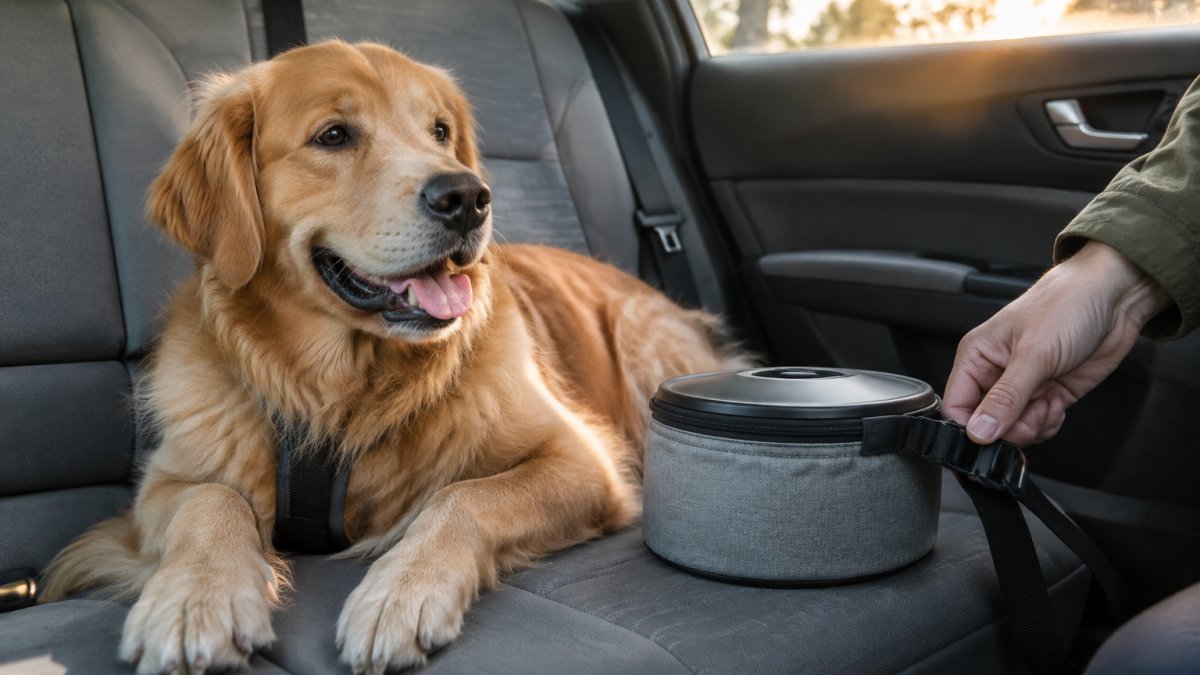
Spill-resistant does not mean spill-proof. If your dog gets anxious in the car, a calmer setup matters as much as the bowl itself, and our comparison of a dog seat belt vs travel crate for car safety covers the restraint side of the equation.
Why a Travel Dog Bowl with Lid Belongs in Your Pack
A travel dog bowl with a lid helps keep leftover water contained and can reduce dust and debris reaching the water on hikes and campsites.
Two habits make lids work: open the lid fully before your dog drinks so the rim does not block their muzzle, and close it before you move, not after. Watch out: a lid that is not seated flat will leak at the seam, and most of those leaks happen in a bag, not on the ground.
Calculating Water and Food Capacity for a Specific Outing
Most people overpack food and underpack water. Use this quick method before you leave:
- Weigh your dog. A 40-pound dog needs roughly 40 ounces of water per day as a baseline.
- Multiply by trip length. A half-day hike is about half that, so roughly 20 ounces.
- Add a heat and activity buffer. Add a quarter more for hot weather or steep trails.
- Divide by bowl volume. Two 350 ml collapsible bowls hold about 24 ounces total, enough for that hike.
- Pack food by meal, not by day. Scoop each meal into a separate bag so you are not measuring on a tailgate.
Cleaning, Drying, and Preventing Odor Buildup
Odor comes from moisture trapped in seams and folds, not the material itself.
Deep-clean weekly on long trips with warm water and mild dish soap, paying attention to fold lines on soft bowls and the rim on rigid ones.
Traveling with a dog asks a lot of your gear, and the bowl is the piece most likely to let you down at the worst moment.
Frequently Asked Questions
Are collapsible silicone bowls safe for dogs?
Silicone bowls are safe when the material is food-grade and free of fillers. Check that the listing names food-grade silicone rather than generic soft plastic, since cheap silicone can hold odor and tear at the fold lines. A collapsible dog bowl like the Pawsome Finds Collapsible Pet Bowl ($14.99) uses high-quality silicone and folds into four layers, which keeps the rim stiff enough to hold water.
How do I choose the right size travel bowl for my dog?
Match capacity to your dog's weight and the length of the outing. The 350ml Pawsome Finds Collapsible Pet Bowl is one option for shorter outings. Medium and large dogs need more volume per stop, so a larger rigid bowl or a dual-compartment design works better. As a rule, offer roughly 1 ounce of water per pound of body weight per day, then split that across your stops. Size up if you hike in heat or your dog drinks heavily.
Are stainless steel or silicone travel bowls better?
Stainless steel resists wear, does not hold odor, and stays put on a wide non-slip base, which makes it the better choice for car travel and camp meals. Silicone wins on packed size and weight, so it suits hiking and day packs. Many owners carry both: a collapsible bowl for the trail and a stainless bowl for the car or hotel room. The Pawsome Finds Non-Slip Dual-Use Stainless Steel Pet Bowl ($57.96) comes in three sizes.
How do I keep a travel dog bowl from leaking in the car?
Choose a bowl with a sealed lid or a leakproof compartment rather than an open rim. The Pawsome Finds Pets Feeding Bowl ($52.60) separates food and water, offers guaranteed leakproof protection, and includes a waste shovel and bag compartment. Place the bowl on a flat, non-slip surface, fill it only partway while the car is moving, and offer water during stops instead of on winding roads. Empty and dry the bowl at the end of each day.
