


Last Updated: October 23, 2026
Quick Summary
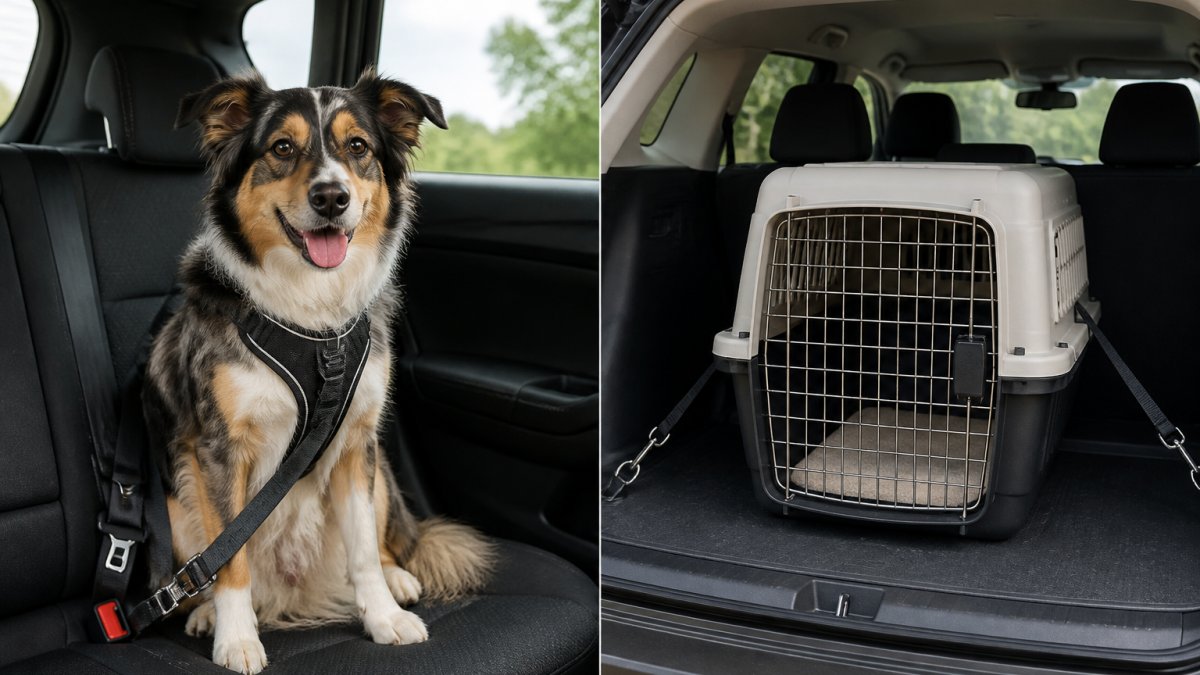
A dog seat belt restrains your dog in place using a harness clipped to the vehicle's seat belt, while a travel crate encloses the dog in a rigid box anchored to the car. A dog seat belt is lighter, cheaper, and faster to set up, while a travel crate gives you a stronger barrier between your dog and the front seats.
- Measure chest girth behind the front legs and check straps sit flat with two fingers of slack.
- Never clip a harness to a collar in the car, since a sudden stop puts force on the neck.
- Use two straps minimum, one per side, and tug the crate hard after strapping.
- There is no federal safety standard for pet car restraints in the U.S.
- A crate tested with a 30 lb dummy tells you little about a 90 lb dog.
Table of Contents
- Dog Seat Belt vs Travel Crate for Car: The Core Trade-Off
- Dog Car Seat Belt Harness: How It Works and Who It Fits
- Travel Crates: Crates Versus Seat-Belt Harnesses for Vehicle Safety
- How to Secure a Dog Crate in a Car
- Crash-Tested Dog Car Crate: What the Evidence Actually Shows
- Best Dog Crate for Car Travel: Selection Criteria That Matter
- Choosing by Dog Behavior, Vehicle, and Emergency Access
- Conclusion
- Frequently Asked Questions
Dog Seat Belt vs Travel Crate for Car: The Core Trade-Off
A dog seat belt restrains your dog in place using a harness clipped to the vehicle's seat belt, while a travel crate encloses the dog in a rigid box anchored to the car.
This guide from Pawsome Finds breaks down both options by dog size, behavior, and vehicle type, and shows how to install each so it holds in a crash.
Dog Car Seat Belt Harness: How It Works and Who It Fits
A dog car seat belt harness is a padded body harness with a loop or strap that clips into a standard seat-belt buckle, spreading force across the chest and shoulders instead of the neck. A badly fitted harness is worse than none: too loose and the dog twists out, too tight and it rubs until the dog fights it.
Harness Fit and Seat-Belt Attachment
Measure the dog's chest girth behind the front legs, then check the straps sit flat with two fingers of slack. Keep the seat-belt attachment short; a long tether lets the dog build momentum before it goes taut.
- Clip the harness to the seat belt, not the collar
- Keep the dog in the back seat, never the front
- Disable the front passenger airbag if a dog must ride up front
Pros and Cons of a Seat-Belt Harness
Pros: cheap, portable, easy to move between cars, and simple to store. Cons: no rigid barrier, so a determined chewer or a large dog can still reach the front seats.
Travel Crates: Crates Versus Seat-Belt Harnesses for Vehicle Safety
A travel crate is a rigid or semi-rigid enclosure that holds the dog in one place and keeps it from becoming a projectile. The crate itself must be anchored, or it becomes the hazard. Crates versus seat-belt harnesses comes down to containment: a harness restrains the dog, while a crate restrains it and blocks contact with passengers.
Crate Suitability and Comfort During Travel
The crate should let the dog stand, turn around, and lie down flat. Too big and the dog slides around on turns. Too small and the dog panics.
- Add a familiar blanket so the crate smells like home
- Skip loose toys that can become missiles
- Leave the crate open at home so the dog chooses it
Crates Versus Seat-Belt Harnesses: Pros and Cons
| Feature | Seat-Belt Harness | Travel Crate |
|---|---|---|
| Setup time | Under a minute | Several minutes |
| Cost | Lower | Higher |
| Barrier from front seats | None | Full |
| Best for anxious dogs | Mixed | Often better |
| Space needed | Minimal | Substantial |
| Fits small cars | Yes | Tight |
How to Secure a Dog Crate in a Car
Knowing how to secure a dog crate in a car is the step people skip. An unsecured crate slides, tips, and can crush the dog in a hard stop. Use the vehicle's anchor points: most SUVs and hatchbacks have cargo tie-down loops, and some have seat-back tether anchors or cargo rails. Run straps through the crate's side vents or handle points and cinch them tight.
Crate Anchoring and Vehicle Anchor Points
- Route straps through the crate frame, not the door
- Pull the crate against the seat back so it can't slide forward
- Use two straps minimum, one per side
Common Installation Mistakes That Undermine Protection
Most crate failures in a crash trace back to installation, not the crate. The recurring mistakes:
- Strapping the door instead of the frame. The door is the weakest part of most crates; a strap through the door handle can pop the latch open on impact.
- Using one strap. A single strap lets the crate pivot. Two straps, one per side, resist rotation.
- Leaving slack. An inch of slack lets the crate build momentum before the strap goes taut, multiplying the force on the anchor.
Matching the Crate to Your Vehicle Layout
Where the crate goes depends on the vehicle:
- SUV or hatchback with a cargo area: anchor the crate to the cargo tie-down loops and brace it against the seat back.
- Sedan with a trunk pass-through: a crate in the trunk is only safe if it is anchored and the pass-through is not the only ventilation source.
- Pickup truck: a crate in the open bed is exposed to weather and road debris; a secured crate in the cab is the safer choice when it fits.
Checking the Setup Before Every Trip
A quick pre-trip check takes under a minute and catches the failures that matter:
- Push the crate hard toward the seat back and side to side. It should not shift more than a fraction of an inch.
- Check that the straps are tight and the buckles are locked.
- Confirm the crate door is latched and the latch is not bent.
- Make sure nothing loose is inside the crate that could become a missile.
- Recheck after the first ten minutes of driving, since straps can settle.
A crate that fails this check is a hazard you are carrying with you.
Crash-Tested Dog Car Crate: What the Evidence Actually Shows
A crash-tested dog car crate has been put through a simulated collision and held together. That's the whole claim. It does not mean the dog walks away unhurt, and it does not mean the crate is certified by any government body.
Here's the honest part: there is no federal safety standard for pet car restraints in the U.S. The National Highway Traffic Safety Administration regulates child seats and seat belts, not dog harnesses or crates.
What "Crash-Tested" Actually Means
In practice, a crash-tested claim usually means the manufacturer ran the product through a dynamic sled test or full-vehicle crash simulation and published a pass result. The variables that matter are test speed, dummy size and weight, and whether the product stayed intact and kept the dummy contained.
A meaningful test report typically states:
- The impact speed (many independent tests use a simulated frontal impact in the 30 mph range)
- The test dummy's weight, so you can compare it to your dog
- Whether the crate or harness stayed attached to the anchor points
If a product page says "crash-tested" but lists none of those details, treat it as a marketing claim, not evidence.
Pawsome PawCruiser™ Backseat Extender →
Independent Testing Versus Manufacturer Testing
The Center for Pet Safety runs independent crash tests and publishes results for pet restraints that meet its criteria. That is the closest thing to a public benchmark in the U.S. Manufacturers that submit to independent testing usually publish the report; many that test in-house do not.
A common pattern is a brand showing a video of a crate on a sled with no stated speed, no dummy weight, and no pass/fail criteria.
Impact Protection and Injury Risk Compared
Impact protection depends on how the force is spread: a crate spreads it across its shell and anchor straps, a harness across the dog's chest and shoulders. Neither removes the risk.
- A harness can cause chest and rib injuries in a severe crash if the tether is long or the fit is loose
- A crate can fail at the door latch, the shell, or the anchor straps
- An unsecured crate becomes a projectile and can injure both the dog and passengers
The National Highway Traffic Safety Administration treats pets as a driver-distraction risk, and a loose dog is exactly that. Restraint protects the people in the car too, which is why the choice is not only about the dog.
How to Read a Crash-Test Claim Before You Buy
Use this checklist on any product page:
- Find the test speed. A claim without a speed is not comparable to anything.
- Find the dummy weight. A crate tested with a 30 lb dummy tells you little about a 90 lb dog.
- Check the anchor method. The test should match how you will actually install it in your vehicle.
- Look for the failure mode. A good report says what broke, not just that it passed.
- Prefer independent results. Manufacturer-only testing is better than nothing, but independent testing is stronger evidence.
None of this makes a crash-tested product pointless. It makes the label something you verify instead of trust.
Best Dog Crate for Car Travel: Selection Criteria That Matter
The best dog crate for car travel fits your dog, fits your cargo area, and can be strapped down. Size and anchoring beat brand names.
Selection criteria, in order:
- Crate size. The dog stands and turns without crouching.
- Material. Plastic crates are lighter and easier to clean. Metal crates are stronger but heavier.
- Door latch. A metal latch holds better than a plastic clip.
- Anchor points. Look for molded slots or handle openings for straps.
- Ventilation. Slotted sides on all four walls, not just the door.
Crate Size, Material, and Airline-Approved Design
An airline-approved crate meets carrier size rules for cabin or cargo travel, useful if you fly, but it says nothing about crash safety. A plastic crate with an enclosed design calms many dogs; a metal crate gives more airflow but less visual cover. Match the material to temperament.
Choosing by Dog Behavior, Vehicle, and Emergency Access
Pick by dog first, car second. A gear-shy or anxious dog often does better in an enclosed crate; a dog that panics in small spaces does better in a harness.
- Anxious or reactive dog: enclosed crate, covered on three sides
- Senior or arthritic dog: harness with a low step-in design
- Small car, no cargo space: harness on the back seat
For back-seat setups, a seat cover keeps the dog from sliding on leather and protects your vehicle interior. Our Pawsome PawCruiser™ Backseat Extender is a waterproof, nonslip hammock that gives a harnessed dog a stable surface, priced at $79.99.

Conclusion
The hard part isn't picking a side in the dog seat belt vs travel crate debate. It's committing to a setup that fits your dog and your car, then installing it properly every trip.
At Pawsome Finds, we stock gear that makes safe travel simpler, backed by free worldwide shipping and a 60-day money-back guarantee.
Get started with Pawsome Finds and build a car setup your dog can actually relax in.
Frequently Asked Questions
Is a dog seat belt or travel crate safer in a car?
Neither wins outright. A crash-tested dog seat belt harness keeps your dog on the seat and out of the front airbag zone, which suits dogs that ride well on a seat. A crash-tested travel crate contains the dog fully and protects against loose-object injury, but only if it is anchored to a vehicle anchor point and sized correctly. The deciding factors are your dog's size, behavior, and whether your vehicle can fit and secure a crate. Untested gear in either category offers little real protection.
How do you secure a dog crate in a car?
Push the crate against the back of a seat or the cargo-area wall so it cannot slide forward. Run the seat belt through the crate's designated belt path, or use straps rated for the crate's weight to tie it to cargo anchors or the seat's tether points. Check for movement by pushing the crate side to side; it should shift less than an inch. Avoid stacking luggage on top, and never leave the crate unanchored, since an unsecured crate becomes a heavy projectile in a collision.
Should a dog wear a seat belt in a car?
A seat-belt harness is worth using if it fits well and the product is described as crash-tested. The harness should sit flat against the chest, not press on the throat, and the seat-belt attachment should be short enough that your dog cannot reach the front seat or window. A loose dog creates driver distraction and can be thrown into passengers during braking. If your dog is gear-shy or panics in a harness, a secured crate is usually the calmer option.
Can a dog ride in a regular crate in the car?
A regular plastic or metal crate can work for short trips if it is anchored and the dog fits with room to stand and turn around. It will not offer the same impact protection as a crate built and tested for vehicle use, so treat it as a containment tool rather than a crash safety device. Check that the crate's door latches hold under pressure and that the crate does not block your view or the rear hatch. For highway driving, prioritize a crash-tested crate or a crash-tested harness.
