


Last Updated: November 3, 2026
Quick Summary
Choose durable pet travel gear by checking construction at the points that fail: stitching density at stress points, zipper gauge and backing, metal rather than plastic hardware, and a frame that holds shape but flexes under load. Measure your pet standing and size up on floor area, never down on weight rating.
- Soft-sided carriers fail first at mesh and zippers; hard-sided carriers fail at latches and shell cracks.
- Add roughly 2 to 3 inches to your pet's length and height measurements for carrier fit.
- Verify carrier dimensions against your specific airline, since no universal in-cabin standard exists.
- Treat a crash tested claim as marketing unless the standard, speed, and test dummy are named.
- Wash fabric shells on a gentle cycle and air dry, because heat breaks down waterproof coatings.
Table of Contents
- What Durable Pet Travel Gear Actually Means
- Dog Travel Gear Essentials for Every Trip Type
- Pet Carrier Size Guide: Measuring for Proper Fit
- Airline-Approved Pet Carriers in Cabin: What to Verify
- Soft-Sided vs Hard-Sided Carriers: Durability Trade-Offs
- The Best Dog Travel Bag for Supplies and How to Pack It
- Durability by Travel Environment: Cars, Planes, and Trails
- Long-Term Care, Wear, and Repair
- Frequently Asked Questions
What Durable Pet Travel Gear Actually Means
Durable pet travel gear is equipment built to survive repeated trips without failing at the points that matter: seams, zippers, closures, frames, and attachment hardware. For a deeper look at durability claims before committing, see our complete buying guide to dog car seat covers.
The ASPCA's pet travel safety guidance makes a related point: gear that keeps a pet contained and comfortable is safety equipment, not an accessory. A carrier that pops a zipper at a rest stop is a hazard, not an inconvenience.
The Four Checks That Separate Built-to-Last From Looks-Good-Online
- Stitching density at stress points. Look at where straps meet fabric. Loose, wide-spaced stitching pulls out first.
- Zipper gauge and backing. A coil zipper without a fabric backing behind it will separate under a determined dog.
- Hardware material. Metal D-rings and buckles outlast molded plastic, which cracks in cold weather.
- Frame rigidity versus flexibility. A frame should hold shape when empty but flex slightly under load. Fully rigid frames crack; fully soft ones collapse.
A common mistake is buying on capacity alone. A bag rated for a large dog is useless if its stitching fails at the handle.
Dog Travel Gear Essentials for Every Trip Type
The essentials change with the trip, and gear that is overbuilt for a vet visit is underbuilt for a hiking weekend.
- Short local trips: a secure carrier or backseat setup, a leash, and water. Nothing more.
- Overnight and weekend travel: add a travel bag for supplies, a collapsible bowl, and a familiar blanket.
- Long-distance and air travel: add an airline-compliant carrier, documentation, and a backup closure.
Anxious travelers need one more layer. Calming an anxious traveler matters as much as the hardware, and it is covered separately in our guide on how to calm your dog during travel.
Pet Carrier Size Guide: Measuring for Proper Fit
Proper fit comes down to three measurements, and getting them right prevents most carrier failures. Measure your pet's length from chest to tail base, height from floor to the top of the head or ears while standing, and weight on a scale. Add roughly 2 to 3 inches to length and height so the animal can stand, turn, and lie down flat.
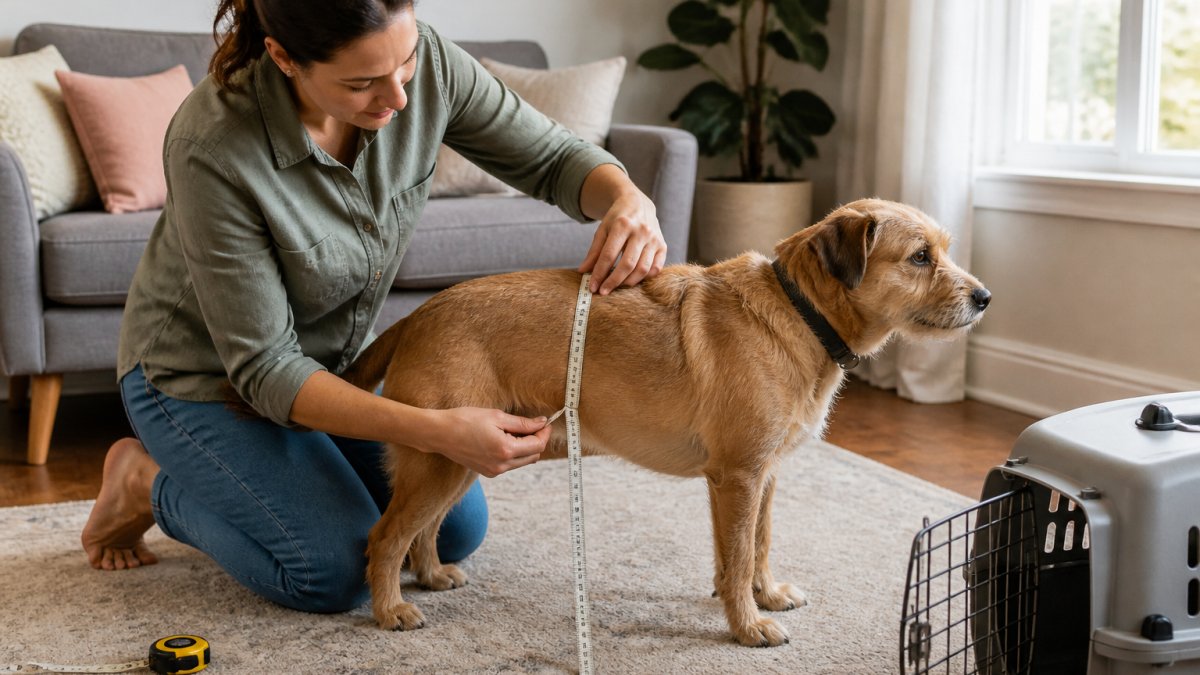
Measure a standing pet, not a curled one, because a carrier sized to a curled position forces the animal against the walls during the trip.
The Fit Test Before You Commit
Numbers on a product page are a starting point, not a verdict. Run this check before the return window closes:
- Stand and turn. Place your pet inside with the carrier open. It should stand without the head touching the ceiling and turn around without crouching.
- Lie flat. The animal should lie down with legs extended, not folded under the chin.
- Door clearance. A pet should enter and exit without ducking or being pushed through the opening.
- Carry test. Lift the loaded carrier by its handle and watch the base. A sagging floor panel means the frame is undersized for the weight, even if the label says otherwise.
Check the weight rating as well as the dimensions, and leave some headroom above your pet's weight.
Sizing for Pets That Do Not Fit the Standard Mold
Standard sizing assumes a young, mobile pet that stands squarely. Senior, anxious, mobility-limited, and large pets need different math:
- Senior and arthritic pets need a lower entry threshold and a firmer floor so they can push up without sinking. A carrier that requires a hop at the door will be refused.
- Anxious pets often do better slightly undersized in height and oversized in floor area, so the walls feel close without forcing a crouch.
- Large and giant breeds frequently exceed the weight rating of soft-sided carriers long before they exceed the dimensions. Check the rating first, then the measurements.
If your pet falls between two sizes, size up on floor area and down on height only if the animal can still stand. Never size down on weight rating to gain a snugger fit; the rating is a structural limit, not a comfort setting.
Airline-Approved Pet Carriers in Cabin: What to Verify
Airline-approved pet carriers in cabin must meet the specific carrier's published dimensions, and no universal standard exists. Each airline sets its own in-cabin limits, so verify against the carrier you are actually flying before purchase.
Check these before you buy:
- Published dimensions for that airline's under-seat space, not a generic "airline approved" label
- Soft-sided construction, which compresses to fit where a hard shell will not
- Ventilation on at least two sides, per most airline policies
The U.S. Department of Transportation's air travel consumer guidance is the place to confirm your rights and the airline's obligations. Confirm the airline's current pet policy directly, since requirements change.
Soft-Sided vs Hard-Sided Carriers: Durability Trade-Offs
Soft-sided carriers win on portability and in-cabin fit. Hard-sided carriers win on structural protection and crash resistance. Neither is universally better, and the right pick depends on how you travel.
| Feature | Soft-Sided Carrier | Hard-Sided Carrier |
|---|---|---|
| In-cabin fit | Fits under most seats | Usually too large |
| Impact protection | Limited | Strong shell |
| Weight | Light | Heavier |
| Ventilation | Mesh panels | Molded vents |
| Wear pattern | Mesh and zipper failure | Cracks and latch wear |
| Best for | Cabin travel, short trips | Car transport, cargo |
Soft-sided carriers fail at mesh and zippers first. Hard-sided carriers fail at latches and shell cracks. Know which failure mode you can live with.
Where Each Type Actually Fails
The table tells you the failure mode; the construction tells you how soon it arrives.
Soft-sided carriers concentrate stress at four points: the zipper tape where the top panel meets the side, the mesh-to-fabric seam at the ventilation windows, the handle attachment, and the floor panel where the frame rod sits. A coil zipper without a fabric backing behind it will separate under a determined dog, and mesh that is stitched rather than bound at the edge frays from the inside out.
Pawsome PawCruiser™ Backseat Extender →
Hard-sided carriers concentrate stress at the door latch, the hinge pins, the shell corners, and the vent grates. Molded plastic shells crack at corners after repeated drops, and latches wear at the spring.
Convenient Is Not the Same as Crash-Tested
This is the distinction most buying guides skip. A carrier can be well made, comfortable, and airline-compliant and still have no vehicle-restraint testing behind it.
A common pattern is a product page that says "crash tested" without naming the test, the speed, or the standard.
For car travel, the safer default is a carrier or crate designed and labeled for vehicle restraint, secured with the vehicle's seat belt or latch system per the manufacturer's instructions, rather than a cabin carrier set loose on the seat. If you are still deciding between restraint styles, our comparison of a dog seat belt versus a travel crate walks through the safety trade-offs.
Watch out: a carrier marketed as "airline approved" tells you nothing about vehicle safety, and a carrier marketed as "crash tested" tells you nothing about under-seat fit.
The Best Dog Travel Bag for Supplies and How to Pack It
A good dog travel bag keeps food, water, waste bags, and medication organized. Pack in this order:
- Food in a sealed container, portioned per day
- Water and a collapsible bowl
- Waste bags and cleaning wipes
- Medication and a copy of vaccination records
- A familiar toy or blanket
Our Collapsible Pet Bowl is made of silicone, folds down for storage, and includes a portable hook for carrying.

Watch out: packing food loose in the main compartment invites spills that soak the whole bag. Use a sealed container every time.
Durability by Travel Environment: Cars, Planes, and Trails
Different travel settings place different demands on gear, so the same bag rarely suits every setting.
For car travel, a backseat setup beats a loose carrier. Our Pawsome PawCruiser™ Backseat Extender is a backseat option for car travel.

For trails, weather resistance is an important consideration. A Consumer Product Safety Commission recall database check before buying used gear is worth two minutes.
Long-Term Care, Wear, and Repair
Most travel gear dies from neglect, not use. Three habits extend life significantly.
- Wash fabric shells on a gentle cycle and air dry. Heat breaks down waterproof coatings.
- Lubricate metal zippers with a silicone stick, never oil, which attracts grit.
- Inspect seams and hardware before each season, and repair small pulls before they become tears.
Frequently Asked Questions
What should I look for in durable pet travel gear?
Start with four things: stitching and seam reinforcement, closure hardware, fabric weight, and frame structure. Run your hand along seams to feel for double stitching and bar tacks at stress points. Check that zippers have metal pulls and locking sliders rather than thin plastic. Look for tightly woven fabric with a waterproof backing rather than a thin coating that peels. For carriers, a flexible frame that holds its shape when empty signals better construction than a bag that collapses flat.
How do I choose the right carrier size for my dog?
Measure your dog standing, from the base of the tail to the tip of the nose, then from floor to the top of the head or ears. Add 2 to 3 inches to each number so your pet can stand, turn around, and lie down flat. Compare those figures to the carrier's interior dimensions, not the exterior. A carrier that lists only outside measurements can be several inches smaller inside once padding and frame are counted.
What makes a pet carrier airline approved for in-cabin travel?
There is no single universal approval. Each airline sets its own in-cabin carrier rules, and they change. Confirm the carrier fits under the seat in front of you on the specific aircraft you booked, that it meets that airline's published dimensions, and that it has adequate ventilation on at least two sides. Call the airline before buying if you are unsure. A carrier marketed as airline-approved is only approved for the airlines that actually list it.
Are soft-sided or hard-sided pet carriers more durable?
They fail differently. Hard-sided carriers resist crushing and are easier to wipe clean, but hinges, latches, and door pins are the weak points and cracks are hard to repair. Soft-sided carriers flex with impact and pack flat, but zippers, mesh panels, and seams take the wear. For car travel and tight storage, soft-sided usually holds up better. For cargo holds or heavy handling, hard-sided wins. Match the material to how the carrier will actually be used.
What should I pack in a dog travel bag for supplies?
Pack a collapsible bowl, a leakproof food and water container, a leash and backup collar, waste bags, a towel, any medication, and a copy of vaccination records. Add a familiar blanket or toy to reduce stress. Keep food in a separate sealed compartment so spilled kibble does not coat the rest of your gear. A bag with divided compartments and a wipeable interior liner saves cleanup and keeps the contents from grinding against each other in transit.
How can I tell if a dog travel bag is made to last?
Check the base first, since that is where bags wear out. A reinforced, water-resistant bottom panel outlasts a single-layer fabric base. Then inspect strap attachment points: they should be box-stitched into the bag body, not sewn on as an afterthought. Look at zipper tape width and whether the zipper is covered by a storm flap. Finally, check the interior liner. A wipeable liner that resists staining means the bag stays usable long after fabric-only interiors look worn.
How do I keep my dog comfortable and secure while traveling?
Secure the carrier or seat extender so it cannot slide, then let your pet settle inside with a familiar item. Keep ventilation clear on all sides and avoid covering mesh panels. For car travel, a backseat extender with a nonslip backing and raised edges keeps your dog from sliding into footwells. Offer water at stops rather than leaving a full bowl in reach, and take breaks every two to three hours on long drives so your pet can stretch and relieve itself.
Choosing travel gear that lasts means checking construction before you check the price tag. Pawsome Finds stocks thoughtfully selected pet essentials, backed by free worldwide shipping and a 60-day money-back guarantee, so you can test gear on a real trip with a safety net. Start with our backseat extender for car travel, or browse the full collection. Get started with Pawsome Finds and travel with gear you do not have to think twice about.
